When Military Families Abroad Witness or Experience Traumatic Events
When Military Families Abroad Witness or Experience Traumatic Events
In this blog post, we go through data from our white paper Sources of Trauma in International Childhoods: Providing Individualized Support to Increase Positive Outcomes for Higher Risk Families that applies specifically to military kids who lived abroad during childhood (TCKs). We hope to see this research used to support the well-being of military TCKs globally – before, during, and after their time abroad.

What is a traumatic event?
In this blog post, we discuss three categories of potentially traumatic events. These are events likely to cause either a ‘Big T’ or ‘little t’ trauma impact on the individual. In the “Sources of Trauma” white paper we discuss a research framework behind why such events can be traumatic, and how they can impact young people long term.
- Small-scale events: localized to the household or local community
- Large-scale events: affect a wide area or large community as well as having personal impact
- Witnessed events: when an individual sees something without necessarily being personally involved
Small Scale Events

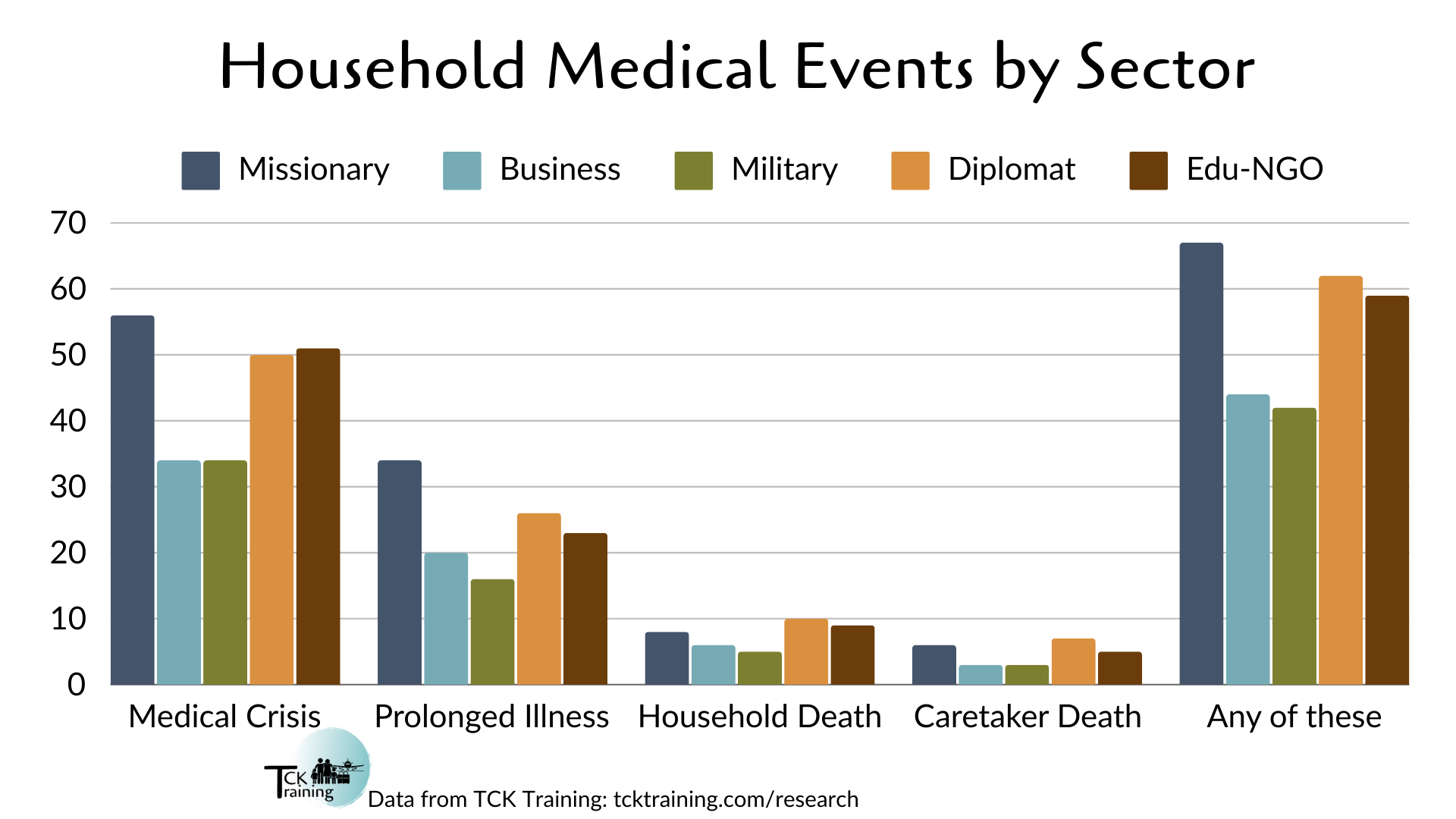
Multiple studies have connected serious medical issues, including chronic illness, with negative impacts on the patient’s family. Importantly, these stressors can impact the family’s long term emotional health. We asked about three categories of medical trauma: (1) medical crisis; (2) prolonged illness; and (3) death.
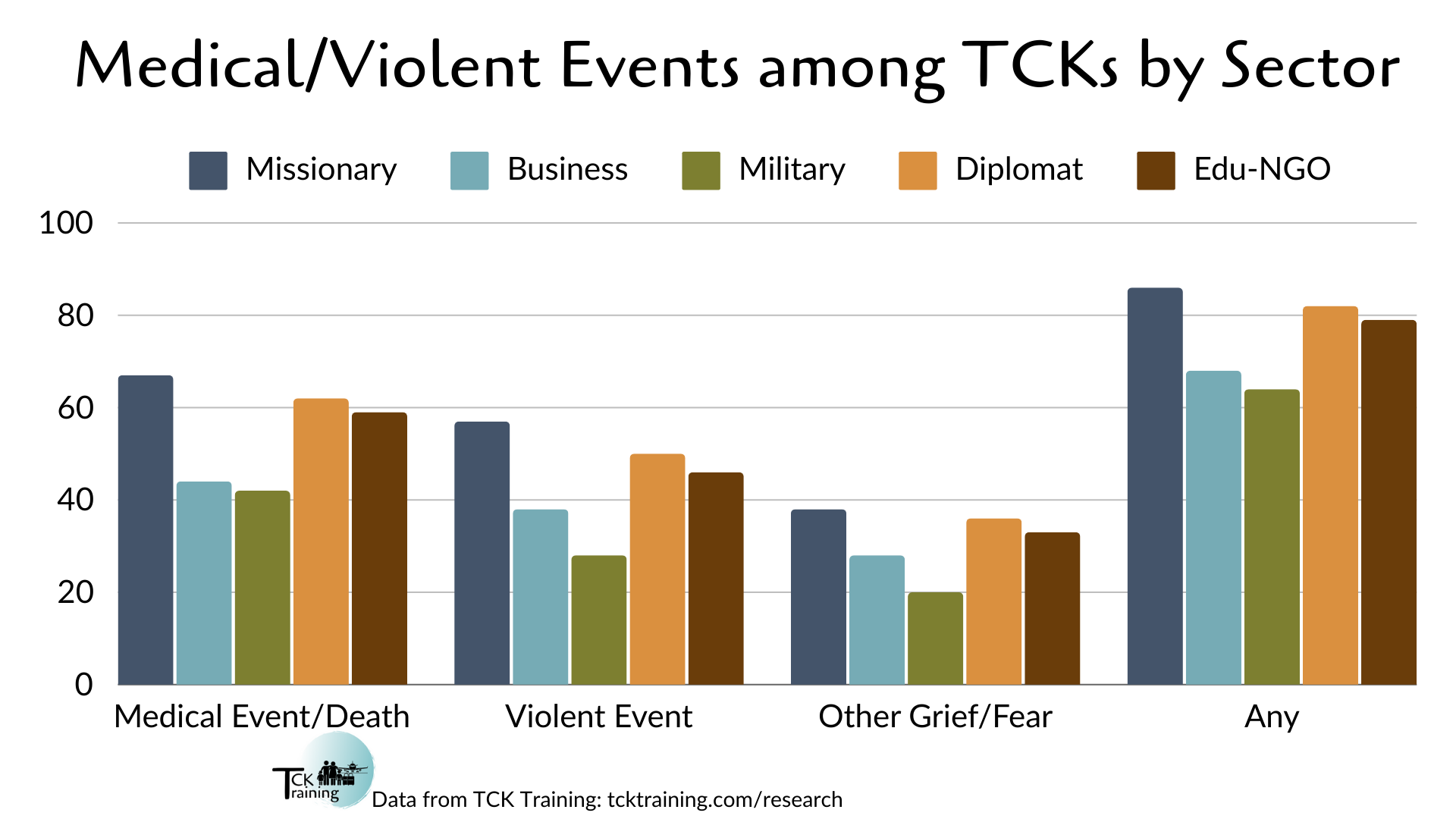
2 in 5 military TCKs (42%) experienced a household medical event during their childhood. There was only a small increase in high-risk ACE scores for military TCKs with this experience (29% vs 25%).
Medical crises affected one third of military families (34%). Military kids who reported a household medical crisis were slightly more likely to have a high-risk ACE score than military kids overall (29% compared to 25%). 1 in 4 military kids (26%) reported prolonged illness in their household; 45% of those had a high-risk ACE score. Medical trauma impacts not only the individual but the family as a whole. TCKs with these experiences were more likely to also report experiencing emotional abuse, emotional neglect, and household adult mental illness.
A small number of military TCKs (5%) reported that a member of their household died while they were a child. This was associated with a modest rise in high-risk ACE scores (29% compared to 25%). 3% of military TCKs reported the death of a non-residential caregiver. While this was a small sample, the ACE risk more than doubled for military TCKs with this experience (57% compared to 25%).
When violence is part of a family’s lived experience, it affects each family member. Our research illustrates how this experience increases the rates of ACEs like physical abuse, emotional abuse, emotional neglect, and mental illness of adults living in the home (such as parents).
- a household member suffering violent harm
- a home invasion/break-in (while the person was home, or while they were away)
- a violent incident occurring at their school while they were present
- a violent incident occurring at another place while they were presenta violent incident occurring in a place they regularly went to while they were not present.
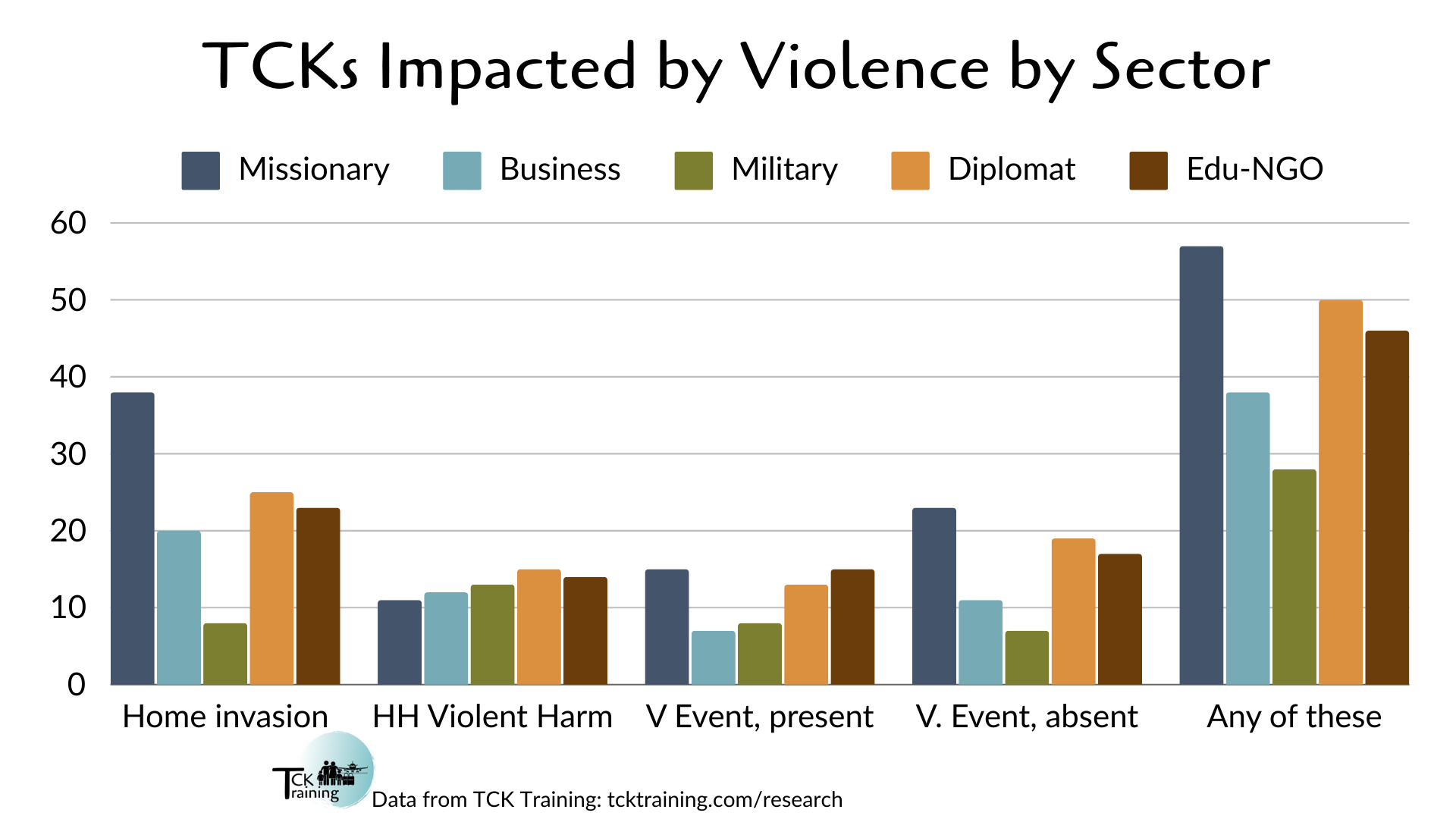
1 in 4 military TCKs surveyed (28%) reported experiencing one of these violent events in their childhood. While this number was still quite high, it was the lowest rate among the different sectors, which suggests that military TCKs live in relatively safe communities due to high-levels of security. Few military TCKs had experienced a home invasion (8%). 1 in 8 military TCKs (13%) reported that a member of their household suffered violent harm; 34% of those military TCKs had a high-risk ACE score, compared to 25% of military TCKs overall.
The survey asked TCKs if they had been present during a violent incident (i.e. armed robbery) at their school or somewhere else in their community, or if such an event happened at a place they regularly went while they were not there. Military TCKs were almost equally likely to report a violent incident occurring in their absence (8%) than when they were present (7%). Violent incidents corresponded with an increase in ACE risk, with a much higher risk for military TCKs who were present during a violent incident than those who were not (43% and 33% respectively).
‘Small-scale’ events that affect TCKs directly in their homes and communities are not small in impact. They have an effect on ACE scores, and create conditions of stress for TCKs and their families. This emphasizes that trauma occurring at any scale can have a significant impact on well-being.
In addition to the small-scale events already mentioned, 1 in 5 military TCKs (20%) reported additional experiences of intense grief or fear. This also comes with a significantly elevated ACE risk (41% compared to 25% in military TCKs overall).
Large Scale Events

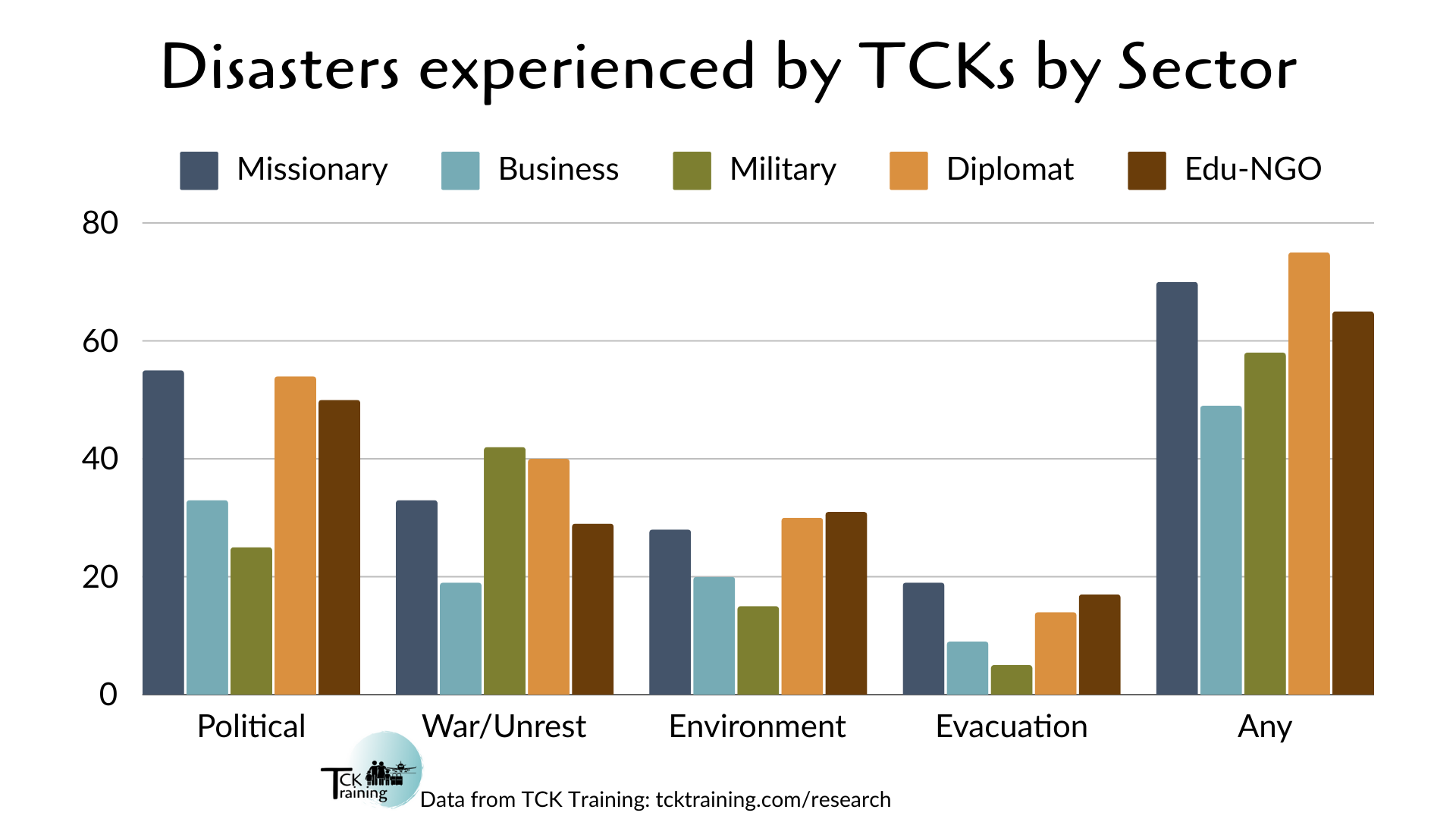
1 in 4 military TCKs (25%) experienced a type of political disruption during their time abroad, the lowest rate among all sectors. While TCKs may consider political violence/corruption minor and thus hardly worth mentioning due to their high frequency (and therefore normalization), this environment contributes to a child’s perception of safety and who can be trusted in the world around them.
Natural Disasters
1 in 6 military TCKs (15%) experienced a natural disaster, such as an earthquake or tsunami. Natural disasters had a larger effect on child maltreatment rates compared to political disruption and war, particularly when it came to emotional abuse and neglect. One third of military kids (33%) that reported experiencing a natural disaster had a high-risk ACE score.
Evacuation
Overall Impact
One quarter of military TCKs (23%) reported experiencing a large-scale potentially traumatic event. Military TCKs who did not experience any of these large-scale events actually had a slightly higher rate of high-risk ACE scores than military TCKs overall (28% vs 25%).
Witnessed Events

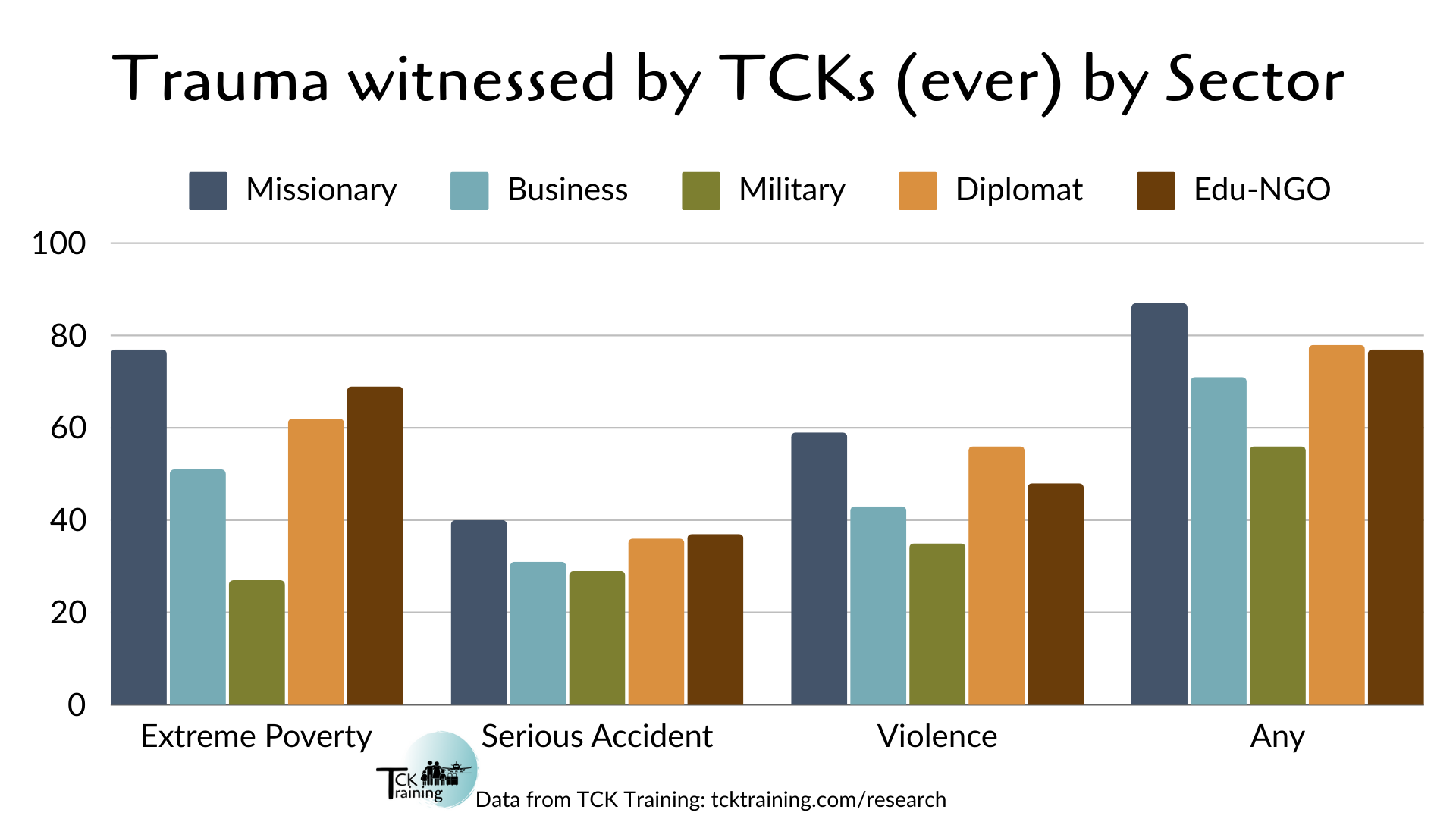
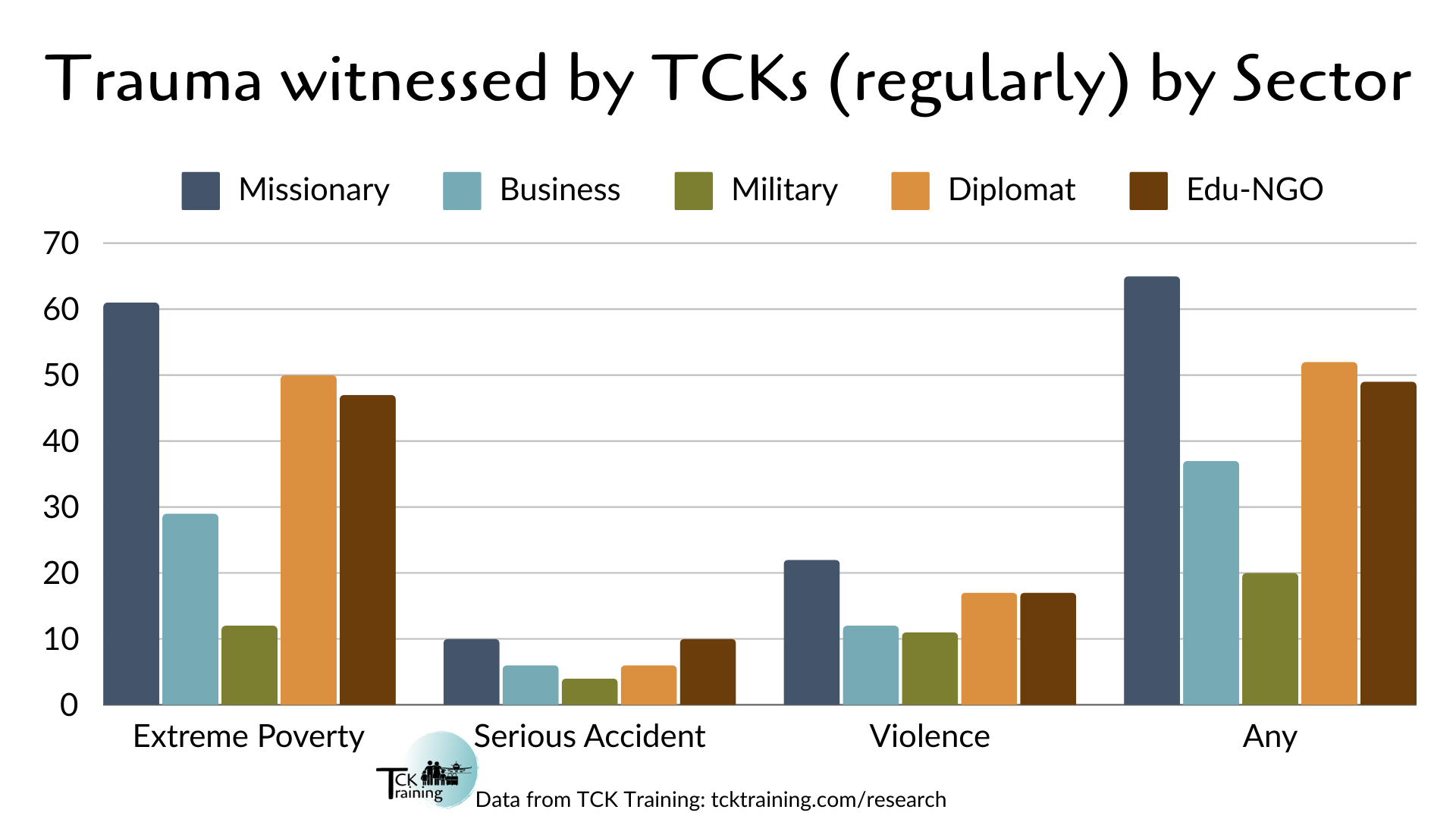
27% of military TCKs reported they had witnessed extreme poverty at least once, and 12% said they witnessed this regularly. This was the lowest rate seen in any sector. Military TCKs who witnessed extreme poverty actually had lower than average ACE scores (23% and 18% respectively).
While witnessing poverty was not correlated with increased ACE risk, it is still worth acknowledging. This is a form of 'moral injury', defined by Foreign Policy as "perpetrating, failing to prevent, bearing witness to, or learning about acts that transgress deeply held moral beliefs and expectations". Children taught that all people are equal, and to treat others with respect and kindness, may struggle to integrate these messages with their lived reality of witnessing people living in extreme poverty.
On the surface, traffic accidents may not seem detrimental. Witnessing any serious traffic accident, however, is likely to cause an adrenal reaction as the body attempts to deal with a stressful situation. We have heard many stories from Adult TCKs who suffered mentally and emotionally from witnessing major injuries and even deaths due to traffic accidents as children. 1 in 3 military TCKs (29%) had witnessed at least one serious traffic accident, while 4% witnessed them regularly. Witnessing serious traffic accidents was associated with higher rates of high-risk ACE scores. 55% of military TCKs who regularly witnessed serious traffic accidents, and 40% of those who witnessed them at least once had high-risk ACE scores.
The category of witnessed violence combines armed conflict, traumatic human death, traumatic animal death, and acts of physical violence. More than one third of military TCKs (35%) had witnessed a violent event, while 1 in 10 (11%) witnessed these events regularly.
8% of military TCKs had witnessed armed conflict. From this small sample, half of military TCKs who witnessed armed conflict regularly had a high-risk ACE score (50% vs 25% of military TCKs overall).
1 in 8 military TCKs (13%) reported witnessing a traumatic human death at least once, including 2 individuals who witnessed a murder. Regularly witnessing traumatic human death, the case for 1% of military TCKs, also doubled the likelihood of a high-risk ACE score (50% compared to 25%).
We also asked about witnessing traumatic animal death, as we have worked with many TCKs and Adult TCKs who had experienced this and needed to process it later down the line. 1 in 7 military TCKs (14%) had witnessed the traumatic death of an animal, with 4% witnessing this regularly. Over half of military TCKs who regularly witnessed the traumatic death of an animal had a high-risk ACE score, more than double the rate seen in military TCKs overall (55% vs 25%).
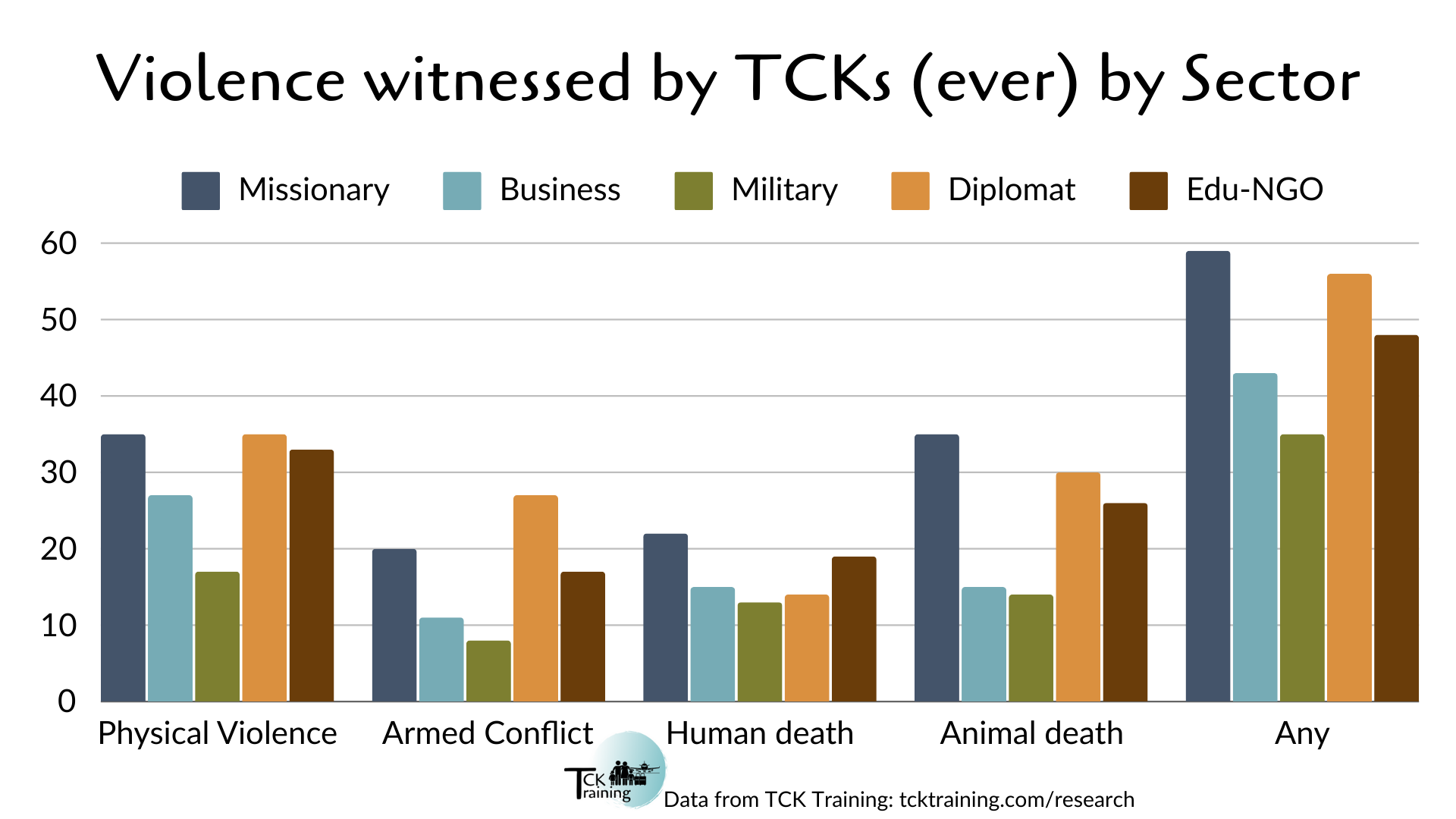
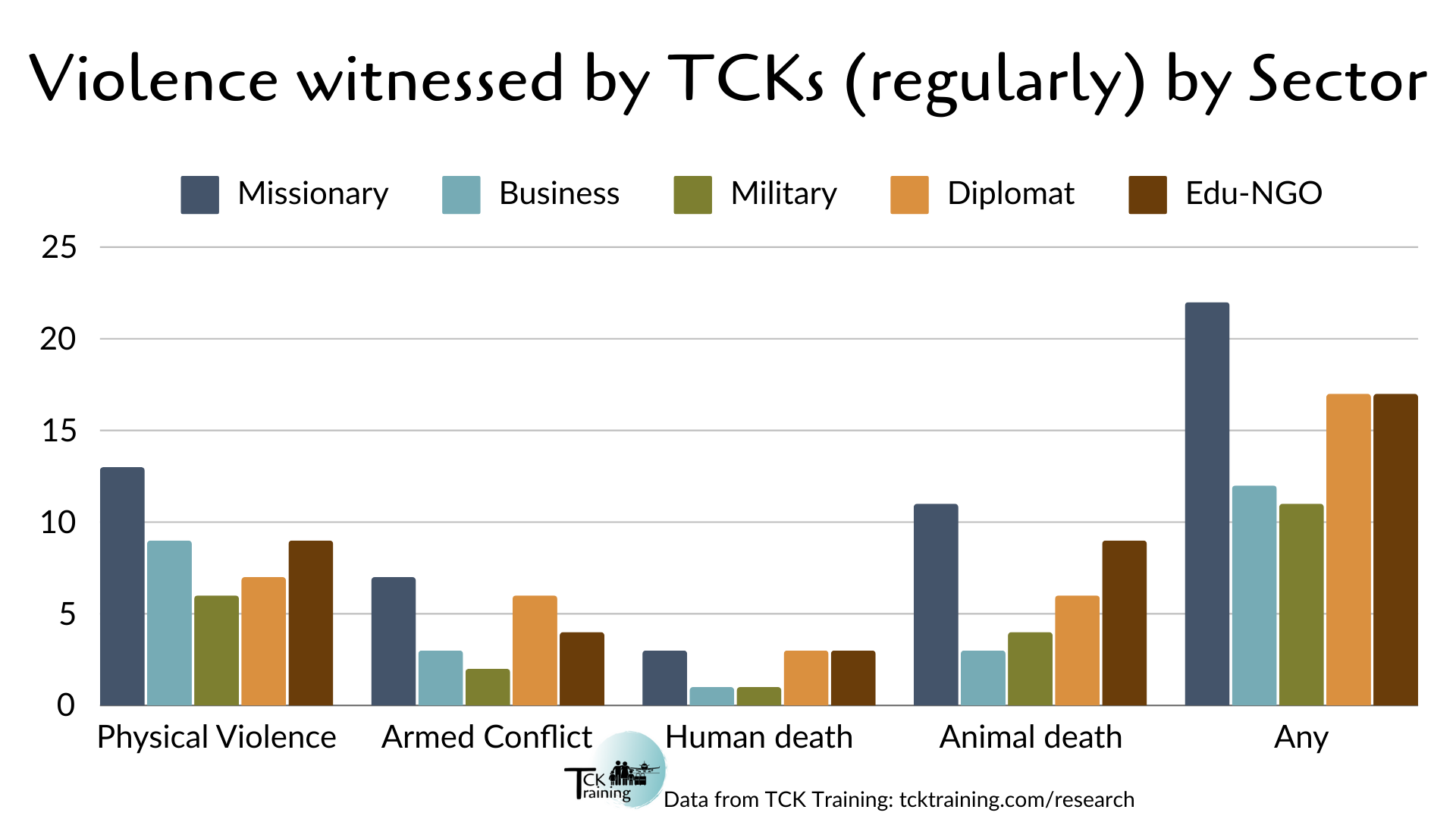
Over half (56%) of military TCKs witnessed at least one of these traumatic events, while 1 in 5 military TCKs (20%) witnessed potentially traumatic events regularly. Among military TCKs who did not witness any of these potentially traumatic events, however, only 16% had a high-risk ACE score (compared to 25% of military TCKs overall).
That said, ACE scores are not the only way to measure the impact of potentially traumatic events, and we anticipate that future research will help us learn more.
Where do we go from here?
As we hold the weight of this, we ask the question: where do we go from here?
Potentially traumatic events threaten the mental health and stability of international families. When we recognize them as such, we can mobilize to acknowledge and debrief these events. These events cannot always be predicted; when changes in the environment threaten emotional/physical safety, especially through frequency of potentially traumatic events, the location’s suitability should be reassessed.
More than this, however, we want to see quality preventive care happen.
Departmental Support is essential for all military families, but especially for those posted abroad. This is a very different move, with additional opportunities but also additional challenges. Providing support that is targeted to the unique needs of military TCKs and the unique challenges of parenting them is key to long term flourishing.
Quality pre-departure training for the military family being posted abroad is essential. A family that has already moved frequently with the military may be unaware of the differences that come with moving internationally, and additional support for this is important. This type of service need not be offered in-house as there are options to out-source pre-departure training, debriefs, and other invaluable services. Parent Packages are a great way to support families by giving them access to resources that will equip them well.
For Caregivers of Military TCKs:
Caregivers, as you read these statistics you may be feeling both motivation that there are needs you want to fill...and overwhelm not knowing how or where to start. You are not alone.
We've personally experienced how nerve wracking it can be to have the big and important role of caring for Military Kids ahead of you, but not feel equipped for it. Which is why we do what we do, we want you to experience the relief and confidence of being equipped and supported!
Get equipped with certifications and trainings
- Pathways Certification (for those in leadership and program development)
- Groundwork Certification (for those working on the ground with Military families)
For Parents of Military TCKs
Reading these statistics can be difficult. We know how much you love your TCKs and you want what's best for them. So please know there is hope!
We do this research because "when we know better we can do better" (Tanya Crossman) and we believe that together we can raise up a generation of healthy TCKs.
We design our resources to equip parents and caregivers to support TCKs according to the needs found in our research!
For Adult Military Kids
If you resonated with a lot of these statistics, we want you to know that you're not alone, and we don't want you to carry this alone!
Here's some resources we would recommend specifically for you:
- Unstacking Your Grief Tower (book)
- Unstacking Your Grief Tower (self-guided course)
- Unstacking Sessions (personalized coaching)
References:
- Caution and Hope: The Prevalence of Adverse Childhood Experiences in Globally Mobile Third Culture Kids (Crossman and Wells, 2022. TCK Training.)
- TCKs at Risk: Risk Factors and Risk Mitigation for Globally Mobile Families (Crossman, Wells and Vahey Smith, 2022. TCK Training.)
- Sources of Trauma in International Childhoods: Providing Individualized Support to Increase Positive Outcomes for Higher Risk Families (Crossman, Vahey Smith, Wells and McCall, 2023. TCK Training.)
- 2021 Survey
- Causes of PTSD: Road Traffic Incidents (PTSD UK, retrieved 2024)
- Mitigating Risk Factors for Children of International Educators and Humanitarian Workers (McCall and Crossman, 2023, TCK Training)
- Caution and Hope for Children of International Educators and Humanitarian Workers (Crossman, 2022, TCK Training)
About the Author
Sahana Kanabar's parents are from two different continents, met in a third, and raised their children in a series of countries while working as educators in international schools. Sahana was a research intern at TCK Training previously, and now works with TCKs at an international school in China.